blendmpc
blendmpc implements four common ways of combining trajectory-optimization MPC with reinforcement learning: residual RL on top of an MPC controller, learned value functions as MPC terminal costs, warm-starting the solver with a learned policy, and collecting MPC rollouts to train imitation policies. These patterns keep showing up in robotics papers as one-off implementations; here they are ordinary library components that work with Gymnasium environments and the Crocoddyl and acados solvers.
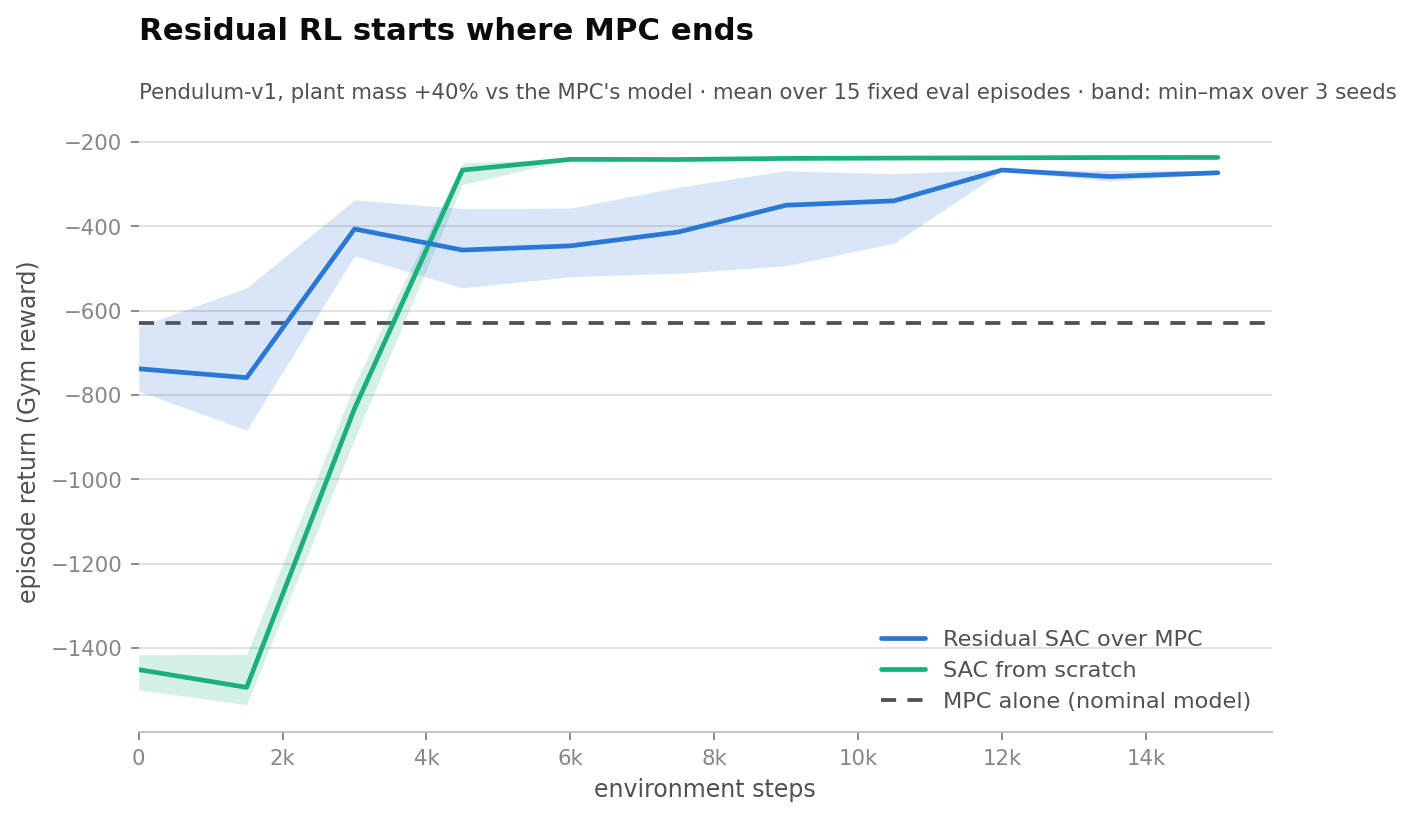
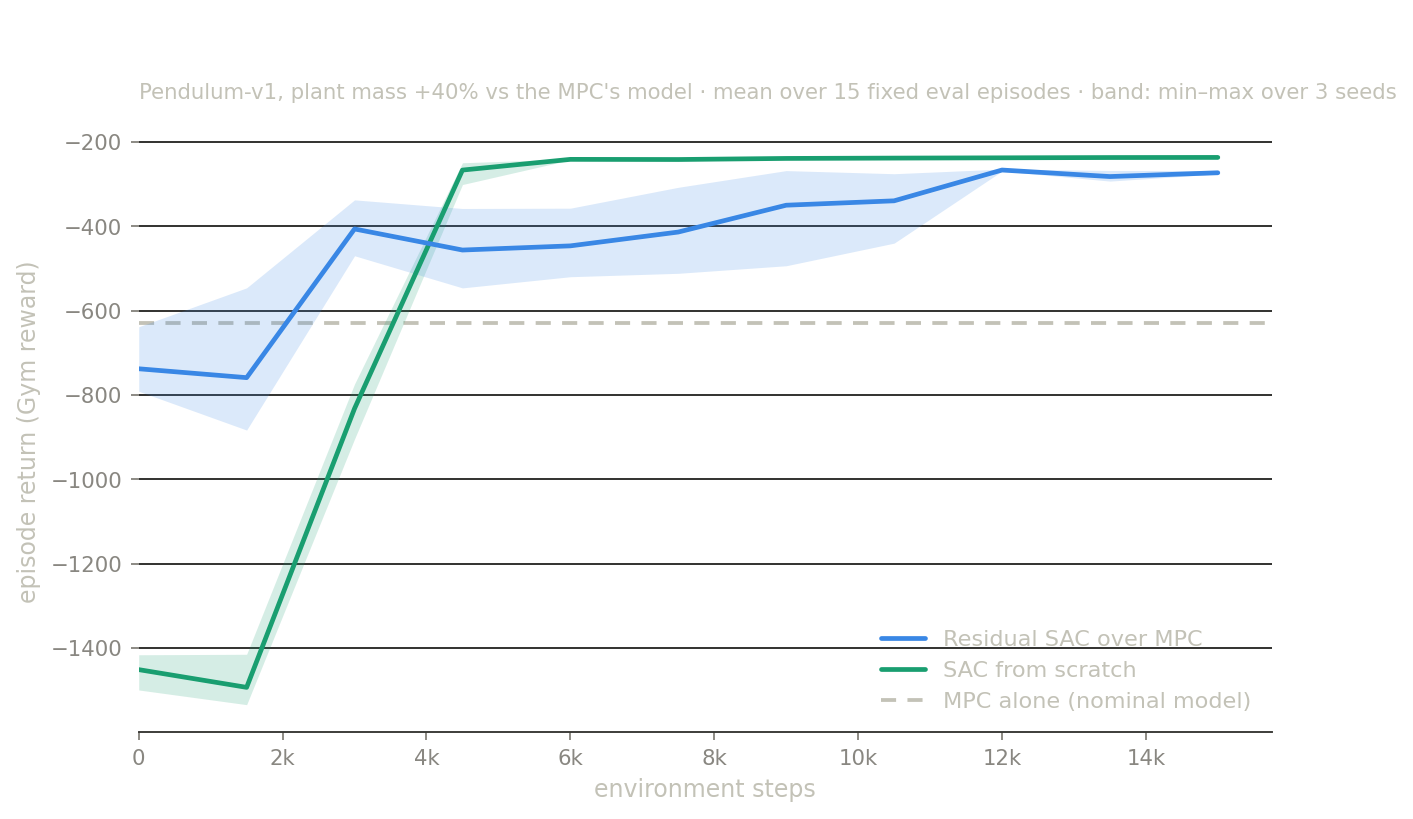
The model-mismatch benchmark: the plant is 40% heavier than the MPC's model. Residual SAC starts where MPC ends and never passes through the catastrophic exploration phase that from-scratch RL pays for.
The four blends
| Blend | Pattern | Read more |
|---|---|---|
ResidualMPCEnv |
RL learns a correction on top of an MPC base controller | Residual RL |
PolicyWarmStartMPC |
a learned policy seeds the trajectory optimizer | Policy warm start |
make_learned_terminal |
a learned value function becomes the MPC terminal cost | Learned terminal cost |
collect_expert_dataset |
MPC labels states for policy distillation / DAgger | Expert distillation |
How is this different from mpcrl / mpc4rl?
Those libraries follow the Gros & Zanon programme: MPC is the function
approximator, and RL tunes its parameters. blendmpc is complementary: MPC
and RL stay separate modules that compose — an RL policy from any library
(SB3, CleanRL, ...) plugs in beside a physics-based MPC, in either direction.
Design in one paragraph
Everything composes against one small interface,
blendmpc.MPCPolicy: backends implement
solve(x0, us_init, xs_init) -> MPCSolution, and the base class turns that
into a receding-horizon policy with warm-start shifting. Blends only see the
interface and Gymnasium spaces — never a solver type. A new backend must
require zero changes to blends, and vice versa.