Benchmarks
Residual SAC under model mismatch (Pendulum-v1)
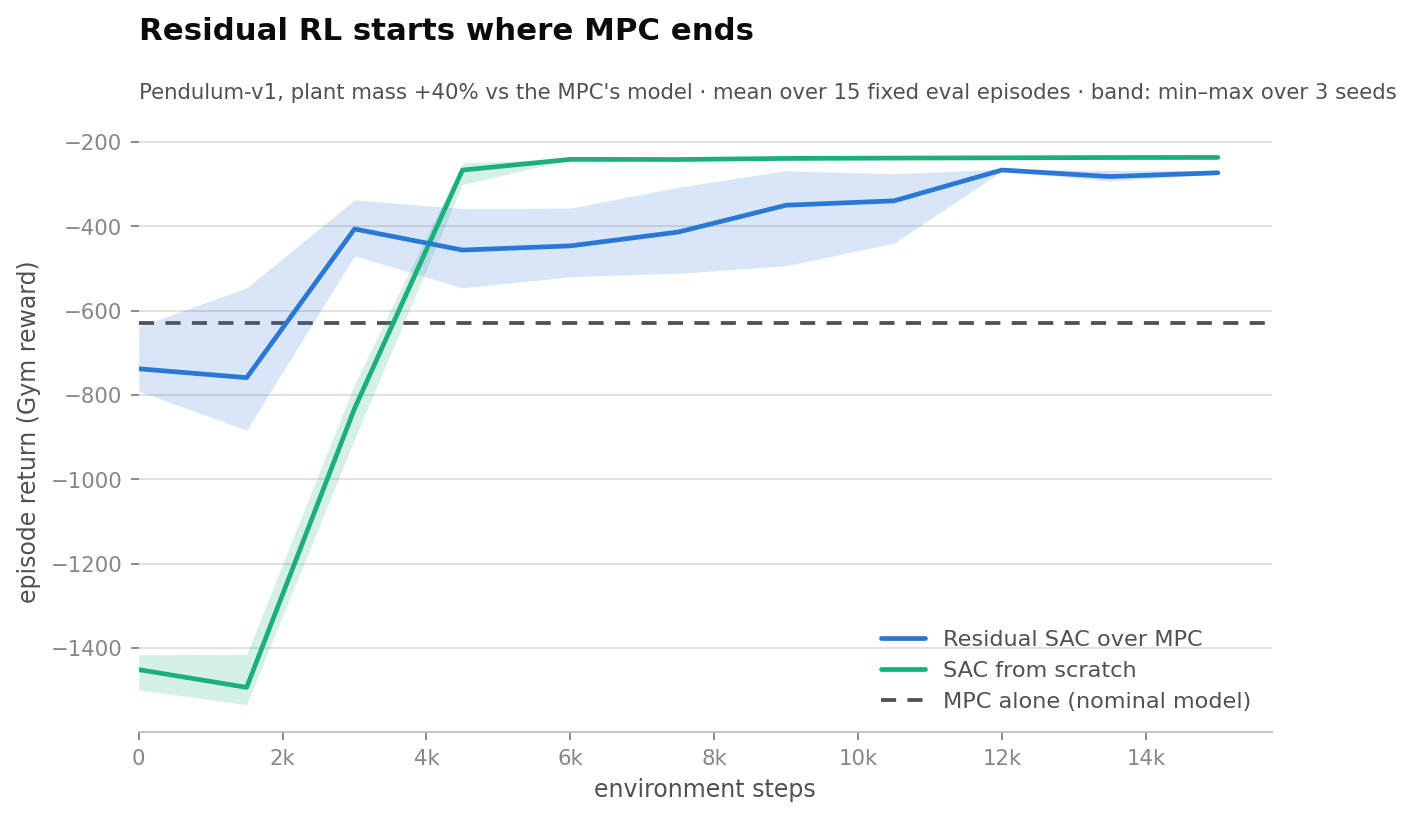
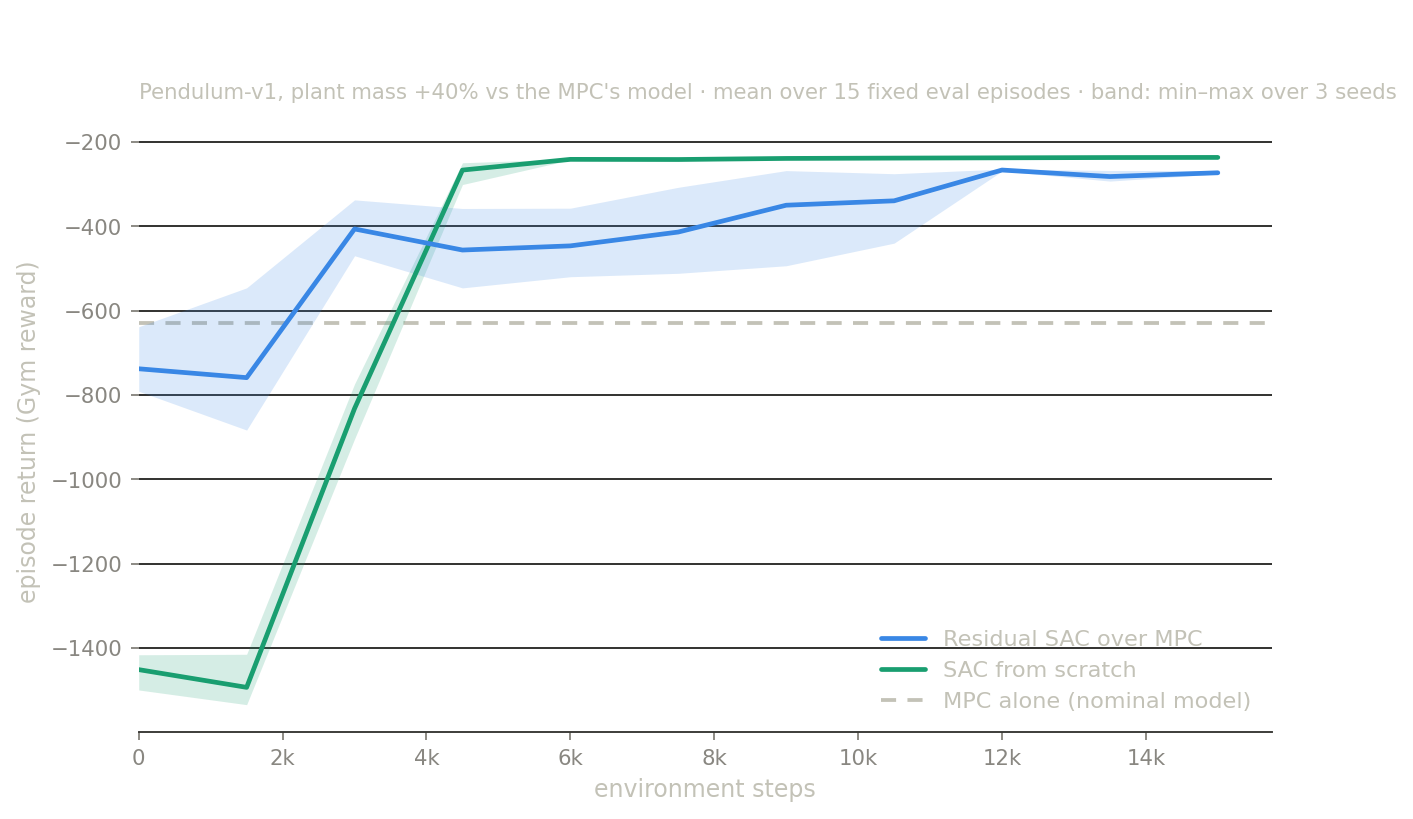
The plant's mass is 1.4; the MPC's Crocoddyl model keeps the nominal 1.0 — a 40% model error. All arms are evaluated on the same 15 fixed episodes; SAC arms use 3 seeds (band = min–max).
| Arm | 0 steps | 3k steps | 15k steps |
|---|---|---|---|
| MPC alone (nominal model) | −629 | −629 | −629 |
| Residual SAC over MPC | −738 | −406 | −273 |
| SAC from scratch | −1452 | −832 | −236 |
Two claims the figure supports: the residual agent never passes through the catastrophic exploration phase (from-scratch SAC sits near −1450 for its first ~2,500 steps — on hardware, that phase is crashes), and it beats the mismatched MPC from ~2k steps on.
Reproduce with benchmark/residual_pendulum/ (about 5 CPU-minutes per arm);
full configuration and honest caveats — including why there is no oracle
line and why residual authority matters — in
that directory's README.
Expert distillation
BC student (2×64 MLP) cloned from the MPC expert; 15 shared eval seeds:
| Arm | mean | worst | latency / action |
|---|---|---|---|
| MPC expert | −320 | −1498 | 0.6 ms |
| BC student (10k pairs) | −423 | −1519 | 24 µs (25×) |
| BC + 1 DAgger round | −558 | −1576 | 24 µs |
Naive MSE-DAgger hurts here: the bang-bang expert gives multimodal labels on
student-visited states, and regression averages them into useless mid-torques.
Details: benchmark/distill_pendulum/.
Policy warm start
The BC student seeds the MPC's cold solves (PolicyWarmStartMPC):
| Arm | mean | worst | upright | iters/step |
|---|---|---|---|---|
| plain MPC | −320 | −1498 | 14/15 | 2.04 |
| policy seed (cold) | −373 | −1492 | 13/15 | 1.95 |
| policy seed (every solve) | −772 | −1816 | 9/15 | 2.64 |
| policy seed + best-of-two | −320 | −1498 | 14/15 | 2.00 |
Seeding is basin selection: it rescues the start that traps plain MPC and
loses a different one. Best-of-two reveals the deeper truth — from a
near-hanging start the hanging plan genuinely has lower open-loop cost over
1.5 s, so no warm start can fix what is really objective myopia. Details:
benchmark/warmstart_pendulum/.
Learned terminal cost
Cost-to-go V(x) as the terminal node — the fix for that myopia:
| Arm | mean | worst | upright |
|---|---|---|---|
| H=30 plain | −320 | −1498 | 14/15 |
| H=8 plain | −1536 | −1614 | 0/15 |
| H=8 + V(MC-1500) | −414 | −970 | 14/15 |
| H=8 + V*(value iteration) | −434 | −790 | 15/15 |
| H=30 + V*(VI) | −649 | −1390 | 13/15 |
An 8-step MPC with a learned terminal out-robusts the 30-step MPC — and V
helps only as a replacement for the missing tail (at H=30 it adds bias, not
information). Implementation traps (cost-unit consistency, float32
finite-difference Hessians, stationary targets, input normalization) are
documented in benchmark/terminal_pendulum/.
Quadruped balance under payload mismatch (Go2)
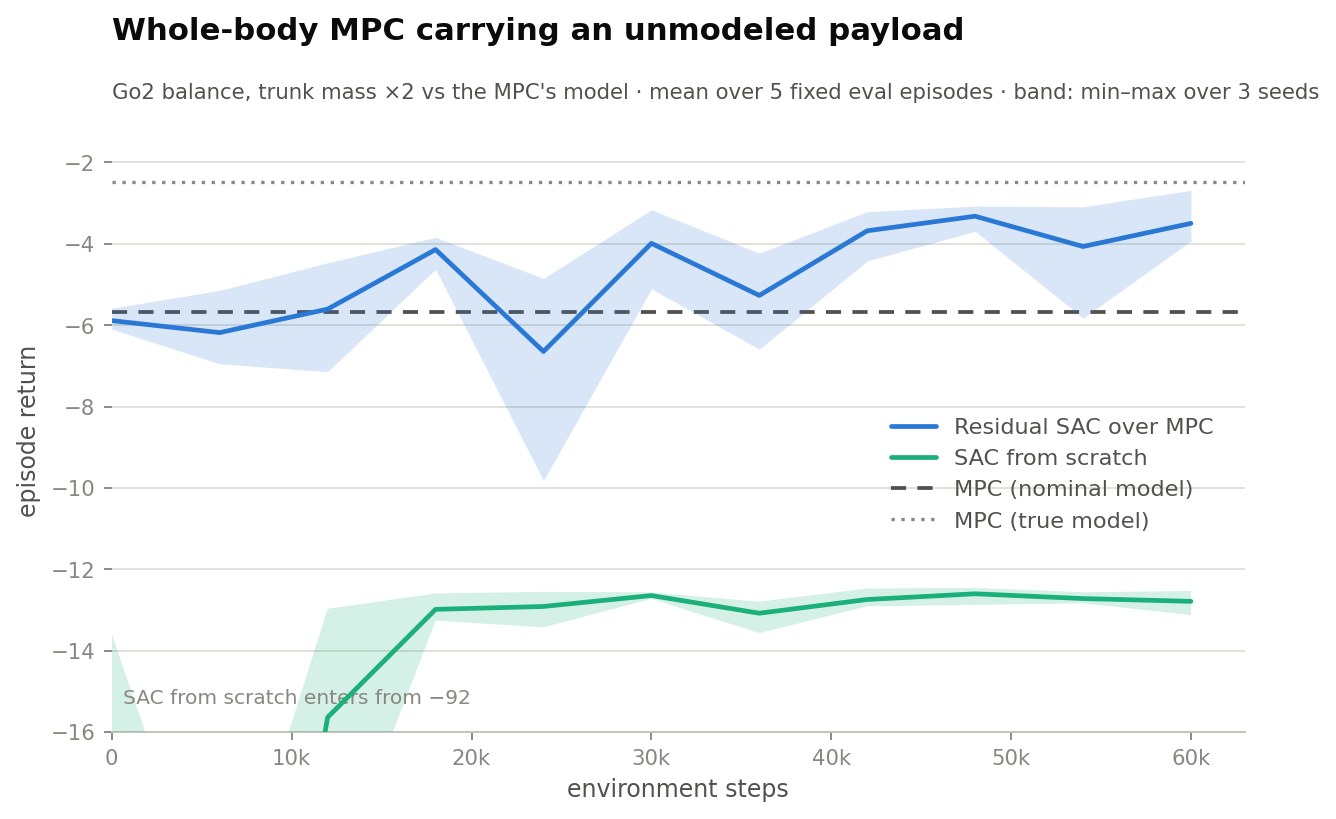
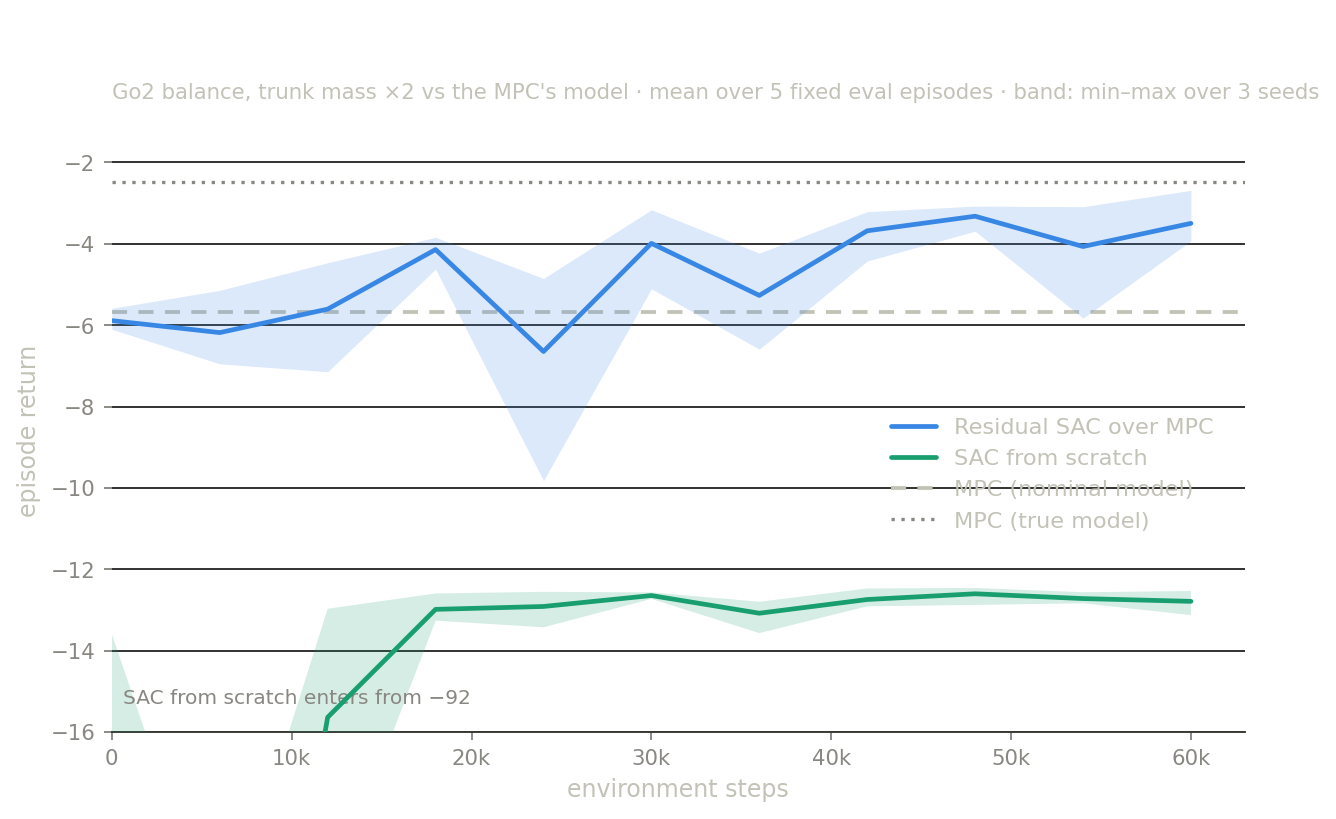
The residual pattern at robot scale: whole-body Crocoddyl MPC (four feet in rigid contact, 37-dimensional state, 12 torques, ~3 ms per solve at 50 Hz) on the MuJoCo menagerie Go2 whose trunk mass is doubled — about the rated payload, unmodeled.
| Arm | return |
|---|---|
| MPC, true-mass model (oracle) | −2.49 |
| Residual SAC over nominal MPC | −3.50 (best seed −2.69) |
| MPC, nominal model | −5.67 |
| SAC from scratch | −12.79 (starts at −92) |
Two findings that differ from the pendulum, documented in
benchmark/quadruped_balance/: residual authority is a stability hazard on
a platform with unrecoverable states (0.3 authority collapsed evaluation to
−149 before recovering; 0.1 works), and per-step rewards that are small
against SAC's entropy bonus quietly pay the policy to stay noisy — training
rewards are scaled ×100, evaluation is not. Also: Crocoddyl's
ShootingProblem.quasiStatic returned uninitialized memory for this contact
problem; blendmpc.envs.go2.quasi_static_torque computes static torques
analytically with Pinocchio instead.
Quadruped trot under overload (Go2)
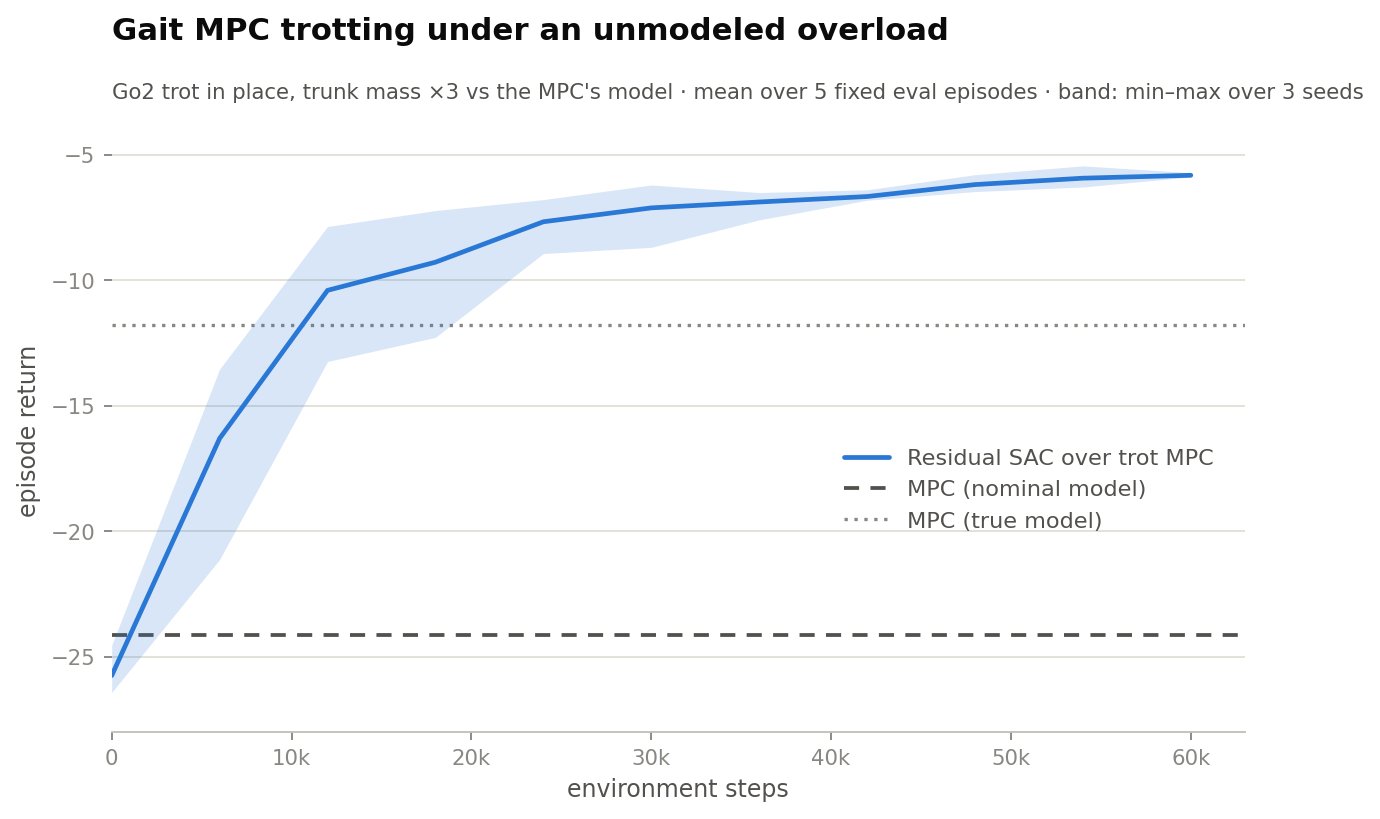
The locomotion milestone: CrocoddylCyclicMPC executes a trot-in-place gait
(periodic contact schedule advanced with circularAppend) while the plant
carries 3× its trunk mass unmodeled.
| Arm | return |
|---|---|
| Residual SAC over nominal trot MPC | −5.81 |
| Trot MPC, true-mass model (oracle) | −11.79 |
| Trot MPC, nominal model | −24.12 |
The residual passes the true-model controller at ~10k steps: the remaining
error is contact timing and soft-contact effects that a rigid-contact OCP
cannot represent, but a learned correction absorbs. Also documented in
benchmark/quadruped_trot/: the gait-degeneration trap (a soft swing cost
produces a "trot" that never lifts its feet — assert on measured contacts,
not plans) and a double oracle inversion (the informed model is worse at 2×
payload, better at 3×).
Distilling the trot MPC (Go2)
A phase-conditioned MLP clone of the gait MPC (benchmark/quadruped_distill/):
| Arm | return | survival | FL airborne | latency |
|---|---|---|---|---|
| Trot MPC (expert) | −6.23 | 5/5 | 22% | 4.0 ms |
| BC student | −6.75 | 5/5 | 22% | 28 µs (142×) |
The student reproduces the gait itself — identical airborne fraction — not just the pose. Phase conditioning is essential: without it the regression target is multivalued and the student collapses to weight-shifting. A horizon ablation (in the trot benchmark README) explains why there is no learned-terminal-cost benchmark at robot scale: with an imposed contact schedule, an 8-node window trots as well as a full-cycle one, and the balance task is better at horizon 2 than 25 — terminal value functions fix discovered long-horizon structure, not scheduled structure.